There is a gap between how organic and paid media are explained online and how small business owners actually experience them in practice.
Most small businesses do not start thinking about paid media because they want to build a sophisticated marketing system. They start thinking about it because they want more customers, more bookings, or more sales, and they are unsure how to get there without wasting money. What makes this difficult is that much of the advice around organic and paid media jumps straight into tactics, platforms, or tools, without explaining the factor that most directly influences performance: the content itself.
Through client work, internships, and exposure to both agency and in-house marketing teams, the same pattern shows up repeatedly. When content is unclear, paid media feels expensive and unpredictable. When content is strong, paid media becomes a way to scale something that already works.
This article explains how content shapes an organic and paid media strategy, and how small businesses can use content intentionally to reduce risk and improve results before increasing spend.
A Simple Way to Think About Paid Media
A paid media strategy is not just running ads. At its core, it is a plan for distributing content to more people with a specific goal in mind, whether that goal is awareness, website traffic, leads, or sales.
What often gets missed is that paid media does not work independently. It does not create interest on its own. It amplifies how people respond to your content.
A helpful way to think about it is this:
Content is the message. Paid media is the megaphone that controls who sees that message and how often they see it. Paid media does not change the content itself.
A paid media strategy is not:
- a shortcut for weak messaging
- a fix for unclear content
- a guarantee that spending more will work
A paid media strategy is:
- a way to scale what is already resonating
- a way to learn faster from real audience behavior
- a way to turn attention into action intentionally
This is why content matters so much. Content is the message. Paid media is how widely that message travels.
Even large platforms reinforce this idea. Meta has shared that creative quality drives a significant portion of sales return on investment. Google has also consistently emphasized that creative effectiveness plays a major role in campaign performance. In other words, distribution matters, but creativity is often the deciding factor.
How Organic Content and Paid Media Work Together
Organic and paid media often feel like two separate worlds. Organic content feels slow and uncertain, while paid media feels fast and risky. For small businesses with limited budgets, this creates tension. There is pressure to invest in paid media without knowing whether the content is ready to be amplified.
The confusion usually does not come from a lack of effort. It comes from a lack of clarity about how these two approaches connect. Without that connection, organic feels like guesswork and paid media feels like gambling.
Content is what connects them.
Organic content reveals how people naturally respond to your message. Paid media allows you to take that message and test it at a larger scale. When these two work together, they form a single, cohesive organic and paid media strategy instead of two disconnected efforts.
How to Use Organic Content as a Testing Ground
Most content starts its life organically. Organic content includes the posts, videos, stories, and interactions you publish without paying for distribution. For small businesses, this is where trust is built and where early feedback appears.
Organic content helps answer important questions before money is spent.
- Do people understand what you offer?
- Do they engage with the message?
- Do they show interest?
When people engage with your content organically, they are showing you how they might respond once that content is amplified through a paid media strategy.
Instead of guessing what might work, organic performance allows you to observe real behavior. Certain actions signal interest, understanding, or intent. These signals help you decide which content is worth promoting and which content still needs refinement.
Organic Signals That Indicate Paid Media Potential
A signal is a measurable action that indicates how people respond to your content. Behaviors that indicate whether your message is being understood, valued, or acted on. These behaviors come directly from your audience, not from assumptions or opinions. Signals help small businesses move from guessing what might work to observing what actually resonates before investing in paid media.
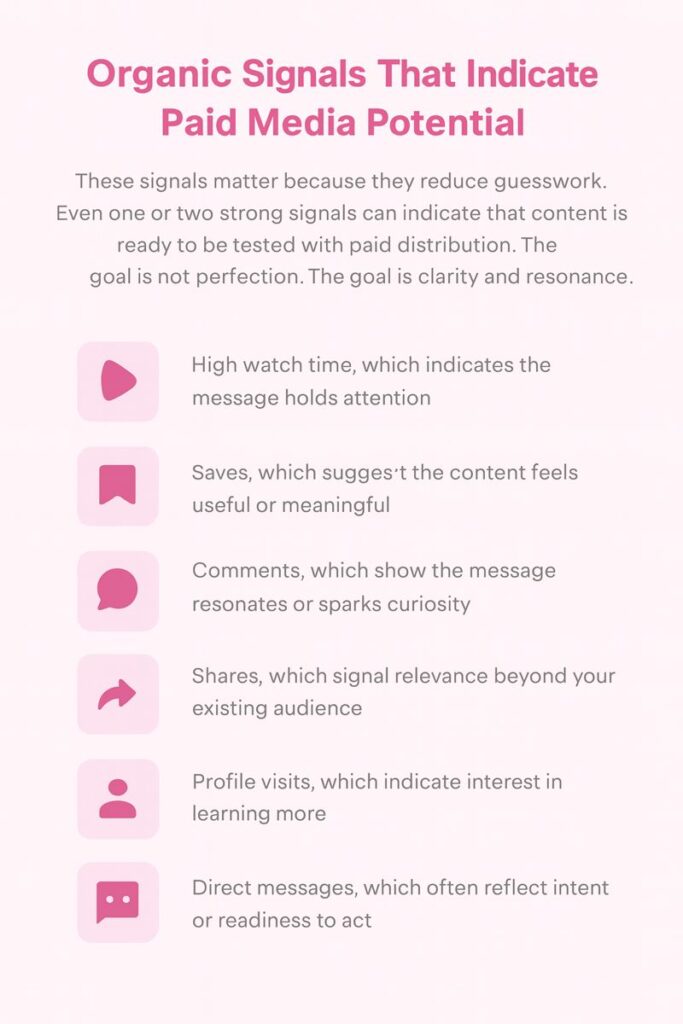
One or two strong signals can indicate that content is ready to be tested with paid distribution.
What counts as a strong signal?
A strong signal is not about hitting a universal benchmark. It is about outperforming your own typical content.
For small businesses, a strong organic signal means a piece of content is performing meaningfully better than your recent or average posts. This relative lift matters more than absolute numbers. A video with 1,000 views can be a stronger signal than a video with 10,000 views if it generates deeper engagement compared to what normally performs on your page.
When an Organic and Paid Media Strategy Is Ready to Scale
Scaling makes sense when content consistently communicates value and engagement patterns are predictable. When increasing spend leads to better results, it is a sign that the message, audience, and distribution are aligned.
If performance declines as spend increases, it is usually a signal to revisit the content rather than push harder.
Paid media works best when it amplifies clarity, not when it tries to compensate for it.
Start Paid Media Without Overcommitting
Small businesses do not need complex funnels or large budgets to start paid media. In fact, starting small is often more effective.
A practical approach looks like this:
- Identify one piece of organic content that clearly communicates value
- Use a small test budget to amplify that content
- Observe how people respond before increasing spend
- Adjust the message based on what you learn
This approach keeps paid media aligned with learning rather than pressure. It allows small businesses to build confidence and insight before scaling.
Final Checklist
With this interactive tool, you can quickly assess the three areas that most influence whether an organic and paid media strategy performs well: message clarity, organic signal strength, and mindset around testing and learning.
See if your content is ready to be amplified!
Content Readiness Checklist for Paid Media
Message Clarity
Organic Signal Strength
Paid Media Mindset
Your Results
More to come!
Daniela Padilla, creator of The Social Community Formula, is a double major in Marketing and Leadership and Business Strategy at Western Michigan University. A content creator and former TikTok intern, she’s passionate about creativity, community, culture, and all things digital marketing.
